THE COLUMBIA ARSENAL
Colonel T.T. Wright of Nashville, known as the father of the Columbia Arsenal, first suggested its location to Congressman W. C. Whitthorne. Whitthorne pursued the suggestion until the act which created the facility was approved May 10, l888, and signed by President Grover Cleveland.
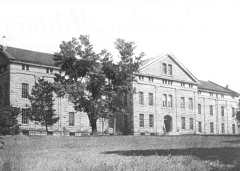
The government spared no labor nor expense in developing and landscaping the property. The U. S. Corps of Engineers and architects concentrated their skills on this project. They laid out drives and walks, graded parade grounds, included flower beds, shrubbery, impressive entrances and even a bubbling fountain. The whole of the property, some sixty-seven acres was enclosed by an iron fence built upon a foundation of the same Bowling Green stone which had been used for the four major buildings. The cost of this fence ran over $20,000. The remaining five buildings were of brick. The overall cost of the project ran well over $500,000, a princely sum in those days. Since the property was outside Columbia city limits water came from a dug well
and was pumped into two 6,000 gallon tanks on the third floor of the manufacturing building, afterward called “Main”. Fire protection was provided by an engine drawn by six horses.
Although Congressman W. C. Whitthorne obtained the facility for Columbia during the first administration of President Grover Cleveland, construction actually began during President Benjamin Harrison’s administration. During William McKinley’s administration the arsenal became a training facility and quarters for Spanish-American War troops until about 1900, when the Chief of Army Ordnance recommended that the Arsenal be closed. In August of 1901 twelve train carloads of arms, ammunition and machinery were shipped to Rock Island, Illinois. After the war the arsenal was declared surplus property and influential people within the state sought an adaptive use for the buildings and grounds and the promotion of a military school began. In June 1904 Company K, 16th Infantry formerly abandoned the arsenal and the property was received by the school.
THE DAWN OF COLUMBIA MILITARY ACADEMY
In 1904 Congress passed the following bill:
An ACT authorizing the Secretary of War to transfer to the Columbia Military Academy certain property in Maury County, Tennessee.
Be it enacted by the Senate and House of Representatives of the United States of America in Congress assembled, That the Secretary of War be, and he is hereby, authorized and directed to convey, by deed duly and properly executed, to Columbia Military Academy, an educational corporation organized under the laws of the State of Tennessee, and its successors, the property in the ninth civil district of Maury County, State of Tennessee, belonging to the Government of the United States, formerly used as an arsenal, and known as the Columbia Arsenal property, the same comprising about sixty-seven acres, and generally bounded by the Hampshire pike, the Louisville and Nashville Railroad, the Mount Pleasant pike, and a public road connecting the two pikes above named, said conveyance to provide, however, that the estate
thereby created shall continue so long only as the said property shall be used for educational purposes only and in conformity with the terms of this Act.
Approved, April 23,1904.
The Columbia Military Academy opened for classes on August 28,1905.
Columbia Military Academy was originally founded as a stock company and remained so until 1949. This corporate organization of stock holders remained through several operating bodies. When one group would experience financial difficulties another would form to continue the school. Because of the original restrictions placed by the federal government which kept the physical plant separate from the school operation and governed by a separate board the property was never in danger.
The depression years of 1929-1931 brought bankruptcy to the administration of Cunningham and A. B. Tarpley. The enrollment had dropped to less than two hundred and two months before the end of the school term the
entire student body was taken by train to Castle Heights Military Academy in Lebanon, Tennessee. Sgt. Aubrey B. Wright, who was the military property custodian and instructor, accompanied the cadets to Lebanon. Since Sgt. Wright was left with the responsibility of the military property and had no duties of instruction, he and John A. Harris, who had been in the commercial department since 1926, actually canvassed people in Columbia to sell stock in the new operating corporation.
Columbia Military Academy was accredited by the following; Association of Military Colleges and Schools of the United States, The Southern Association of Colleges and Schools, Private School Association of the Central States, Southern Association of Independent Schools, Mid-South Association of Independent Schools, Military Schools Training Division ROTC and the National Honor Society.
THE SCHOOL PLANT
The sixty-seven acres of this institution as mentioned above provided one of the most beautiful settings of any
school in the country. The original buildings were impressive in size and architecturally outstanding. A nine hole golf course was laid out on the grounds.
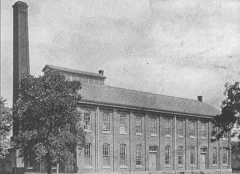
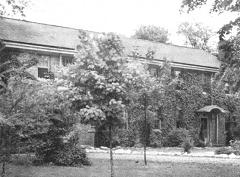
The original power building was converted into a dormitory and named Robert Black Hall. What had been the stables became a dormitory with the addition of a second floor and was named Whitthorne. Moore and Frierson Halls were part of the original plant and were converted to dorms. Moore was named after John Trotwood Moore, a distinguished author and poet, who was born in Marion, Alabama. Frierson was named for Meade Frierson who died in WWI.
Classes were held on the first floor of Old Main (or Polk Hall as it was officially but rarely called) and the second floor was used as a dormitory. . The former commandant’s quarters were occupied by the school president but students preparing for the service academies were billeted on the upper floors.
Faculty officers had apartments in all the dorms and were
there for discipline and counseling.
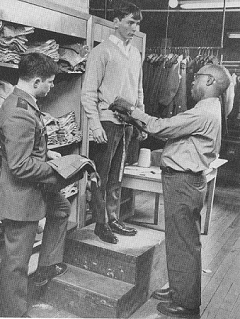
The basement of Old Main provided space for the dining hall and kitchen and the QM or Quartermaster stores. The barber-shop also was located there. There was a bowling alley in the basement of the administrative or Office building. The rifle range and military tactical practice or “sand tables” were on the third floor of Old Main. This huge open area was also used as an indoor drill hall when weather outside was too bad for drill. Rifles and military equipment were stored in this area and it became known as The Armory.
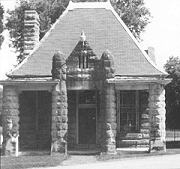
The Guard House was actually used as a brig during the time that troops were quartered there. Just prior to WWII a Mr. Cook and his wife had an apartment there. Mr. Cook very sternly kept the students “in” and the girls “out”. Cadets, who were on guard duty, stopped cars entering the campus and would ask their destination and give information.
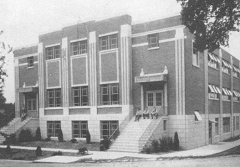
Just prior to World War II several new buildings were added to the campus. Andrew Jackson Hall was built in 1937-38. A new grandstand was erected during that time. In 1941 the new gym was completed and Andrew Johnson Hall in 1942. The new swimming pool and gymnasium were the most up-to-date to be found anywhere. The old gym had a second floor added and became a new dorm, Lee Hall. The old swimming pool was filled in after the glass covering was removed.
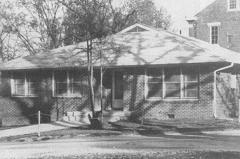
Over the years extensive additions were made to the dormitories and the buildings remodeled and refurbished. In 1953 a YMCA was built and a garage at Jackson. A new hospital building was added in 1956. The original south gate was closed after WWII and a new entrance was made at the corner of Academy Lane and Mt. Pleasant Pike. In 1968 a new Science and Recreation Hall with a snack bar was built and in 1970 a new Junior School building.
THE MILITARY DEPARTMENT
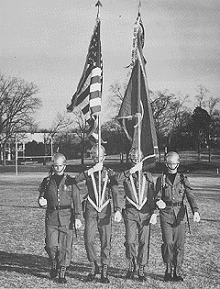
The Military Department was operated exclusively under the direction of the Department of the Army. The Professors of Military Science and Tactics (PMS&T’s) and the non-commissioned officers who taught military science were regular army men. The non-coms were on DEML duty which stood for Detached Enlisted Men’s List. These non-coms were posted for long periods of time at the essential military institutions all over the country. The officers, however, were usually assigned for a three or four year tour of duty.
The habits of regularity, promptness, obedience to authority, courtesy, cleanliness and exactness, which are essential to the soldier, are virtues to the well educated student who is to become an asset to society. For the Academy it provided the control necessary for a well disciplined student body and for the cadets it provided the opportunity to earn and learn the leadership skills they would need for success in later life. At the end of four years of military training which had included weaponry,
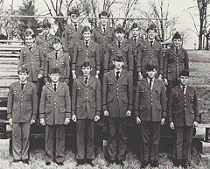
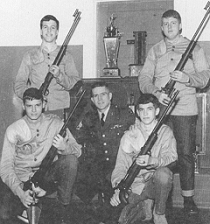
organization, field communications, tactics and other facets of military life the cadet who had so declared received a reserve commission as a 2nd Lieutenant in the Army Reserve. In time of war these men were called to active duty.
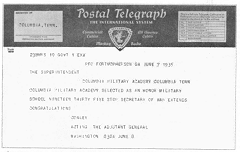
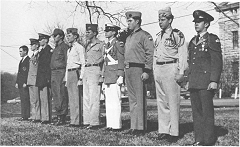
CMA earned Honor School rating in 1935 and remained so until the final days of the military presence in 1975. This designation was given only to those institutions which met the high criteria of the Department of the Army and each spring the Government Inspection was the highlight of the year with every corner of the campus in “spit and polished” condition, as well as the uniforms and equipment. Honor military schools had the privilege of nominating three Honor Graduates for appointments to each of the U. S. Military Service Academies.
Columbia Military Academy was a class “M” Military School until 1918, when a Junior ROTC Unit was added. In 1947 a Senior ROTC Unit was installed and remained until June 1, 1978 when enrollment dropped below the minimum requirement for an ROTC program.
CADETS – THE STUDENT BODY
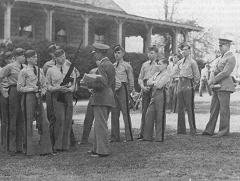
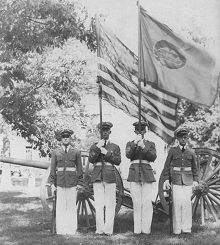
The motto of Columbia Military Academy was “Vincit Que Se Vincit”..”He Conquers Who Conquers Himself.” The young men, and in the latter days of the school, the young women were the life of and the reason for the institution. The echoes of their voices and memories of the marching feet will be impressed for all time in the hearts and minds of all who were privileged to be a part of it.
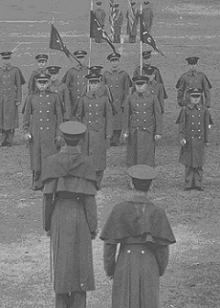
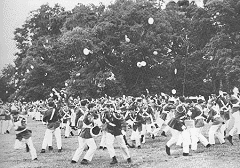
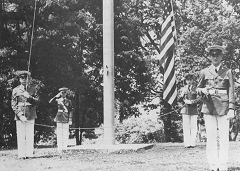
Who could forget the sound of taps, reveille, the counting off, the roars of cadets at a football game, the band playing the Stars and Stripes Forever, or our national anthem, The Star Spangled Banner, with all at attention and saluting, at a Sunday afternoon parade. Who could erase from memory the smells of the dining hall, the hats thrown in the air at commencement, the two by twos marching to church downtown on Sunday, the thrill of honors bestowed and goals accomplished.
THE END OF AN ERA AND OF COLUMBIA MILITARY ACADEMY
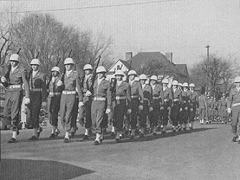
The climate for boarding schools and their popularity declined sharply after the Supreme Court ordered desegregation of public schools in the early 1960’s. Communities all over the south began establishing private day schools, and the more expensive boarding schools faltered. Popularity for the military profession waned with public dissension and outrage over the wasted American lives in an undeclared war in Vietnam. Abolishment of the selective service draft in 1973 only served to justify those sentiments.
Local leadership in Columbia wanted CMA to become a day school also. In an effort to build enrollment CMA began admitting female day students in 1969, who were not required at that time to take ROTC but had the option to do so. In 1978 when too few students were enrolled in the ROTC, it was withdrawn. The local day students did not want the discipline and rigor of military training. The military had been central to the success and pride that
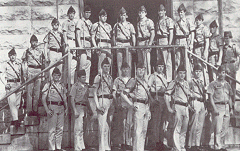
was Columbia Military Academy. Without that heart at the core of the school, it could no longer survive.
The undergirding which had been in place since the school formed in 1904 was removed in 1972 when the Congress relinquished its interest in the property and the whole plant was deeded to the Operating Board for the unbelievable sum of $10,000. The bill to do this had been introduced by Congressman William R. Anderson, the former CMA graduate, (H.R. 10057) and in the Senate by Senators Howard Baker and Bill Brock (Senate Bill 2410). Without the government’s interest, the property could be used as collateral for the rather large debt which ensued. When the debt reached over $850,000.00 the board simply turned the property over to a group of people formed from the Churches of Christ in the Columbia area and Columbia Academy began.
REQUIEM
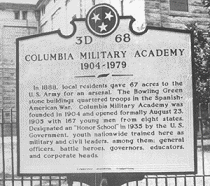
On August 6, 1994, Jeane Walker ’41, PG ’42 and former battalion commander delivered the following at the
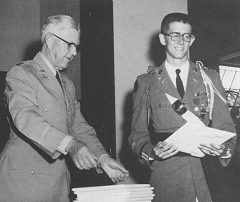
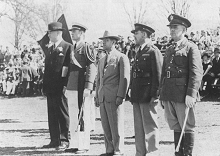
dedication of the historical marker placed at the Main Gate by the CMA Alumni Association.
PREAMBLE
Eight words describe what CMA meant to me and my remembrance of those years: Time Spent…Knowledge Gained…Friendships Formed…Memories Made.
DECLAMATORY
Columbia Military Academy for 75 years stood tall among the greats of the preparatory schools of our nation. Its demise came about nearly a generation ago. Its memory now fades in the disappearing dust of marching cadets, but that memory remains flickering in the hearts and minds of those generations that passed this way.
We of those generations, our hearts swelled with nostalgia, see our ranks grow thin, and we wonder who will tell future generations of this great and honored institution? Who will remember those of that long gray line that marched past? Some marched into history. Others,
many others, to glory in battle, but all, all marched toward the hands of God.
Perhaps this marker we dedicate today will cause someone in the future to pause, reflect and wonder about Columbia Military Academy.
DEDICATORY
So with those words and in the name of the Columbia Military Academy Alumni Association, all of its members, the former faculty, the administrative staff, and all the service personnel we came to know and love, I hereby dedicate this marker to the memory of Columbia Military Academy and that long gray line of cadets that marched past. May that memory be preserved for all of posterity. Thank you and God Bless.
TAPS